
Rush in YYZ: The Fifty Something Tour
- NOV. 1, 2026
- //
- WRITTEN BY RILEY BURSTYN
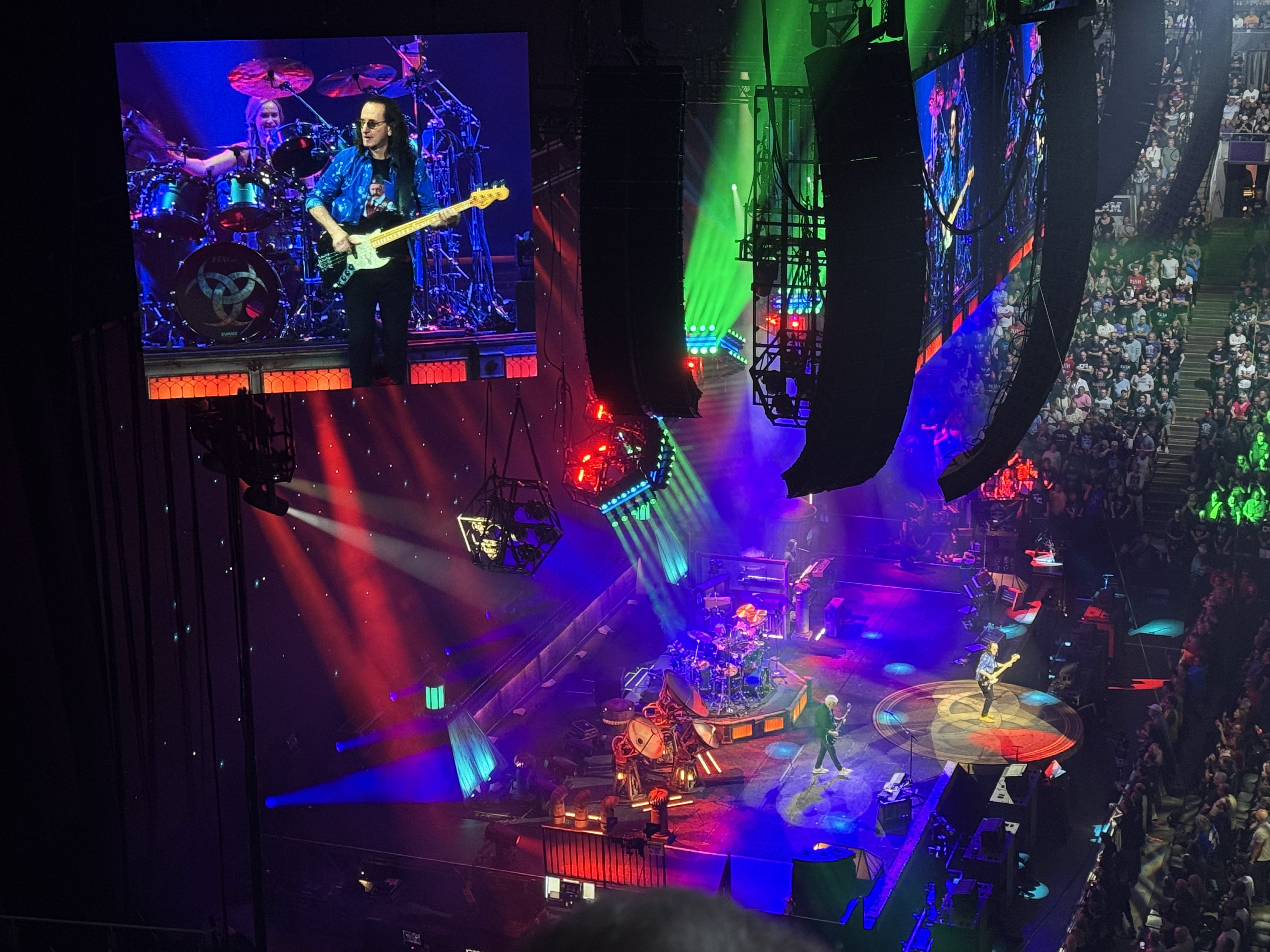
When it comes to legendary Canadian bands, Rush is the name in the ears of Canada’s population. It’s been 11 years since they last toured, and following the death of their drummer in 2020, it seemed Rush would never hit the road again. Then this past October, they announced a 2026–2027 reunion: the Fifty Something tour.
Originating in Toronto’s Willowdale neighbourhood, Rush has existed for “fifty-something” years (58, to be exact). Composed of guitarist Alex Lifeson, singer/bassist/keyboardist Geddy Lee, and late drummer Neil Peart, they have sold over 43 million albums worldwide and were inducted into the Rock and Roll Hall of Fame in 2013.
I attended night two of Rush’s four sold-out homecoming shows with my dad, a lifelong fan who has seen them at least 6 times. Looking down at the crowd in Scotiabank Arena, it was clear everyone had been waiting all those 11 years for this night. Some were dressed up in the iconic red Moving Pictures jumpsuits, others in custom Rush battle jackets, many in old and new tour tees, and one wrapped in a Scottish flag. People had travelled across the world to attend the tour in the band’s hometown, and to our luck, it was being filmed.
We took on the 300s level for a whopping $170 each, but the view looked promising with the massive screen and speakers at eye level. Given the significance of this tour, there were obvious nerves from the crowd, such as whether Lee would sound accurate, and what the show would be like with their first “fourth” member, veteran keyboardist Loren Gold. Particularly though, fans wondered if Anika Nilles, the touring drummer, could live up to Peart’s world-renowned drumming. Peart, ranked 4th on Rolling Stone’s “100 Greatest Drummers of All Time” list, was a massive reason people loved Rush. For someone to fill in his shoes, especially a woman, was a big feat.
Rush didn’t have an opener, but they did have a seven-minute introduction video, full of references from their past. Each time a new reference came on, like the movie “I Love You, Man,” and the South Park “Lil’ Rush clip,” the crowd roared. Every moment was filled with audience members shoulder bumping and giggling, and the tension rose as the video came to a close with Lifeson and Lee’s silhouettes standing behind a screen of blue smoke. The atmospheric introduction to “Xanadu” began, transporting the crowd to a mythic realm amongst the sound of birds, temple blocks, and chimes; the setting of a new journey, the perfect song to open a history-making concert. I still get chills thinking about that first drop when the drums came in, the lights tracking Nilles with every hit she made. Lifeson and Lee held their double-necked guitar and bass, respectively, and smiled out at the crowd, happy to be back.
The crowd welcomed the band with enthusiastic shouts, tears, and many air drum solos. One member of the crowd had red glowing drumsticks and didn’t miss a single beat. Lee thanked everyone for being there, “for still being there,” and they transitioned into their single, “The Spirit of Radio.” People roared equally as loud for every song they played—from their hit singles, to less popular tunes, to songs that hadn’t been played live in decades. Whether you were a new Rush fan or owned their first album right after it was released, one of your favourite songs was guaranteed to be played. They had a rotating catalogue of 40 songs throughout the tour, which resulted in 15/19 of their albums being played. Night two had us lucky enough to hear 12 of those albums, and we were particularly blessed to hear the entire 20-minute “2112” suite.
The stage was dressed as a steampunk rooftop, the lights colourful and synced with each song (red for “Red Barchetta” of course), and the sound permeated the arena so even we, in the nosebleeds, could hear every note perfectly and accurately—better than some other Scotiabank Arena concerts I’ve attended. To our absolute joy, Lee sounded fantastic, exactly like the studio versions for some songs, like “Closer to the Heart.” Lee told Rolling Stone that at 72 years old, he took his first professional vocal lessons to stretch and strengthen his vocal range; it allowed him to sing as accurately to the original songs as he could without changing any keys, bringing back iconic high songs Rush had dropped from their sets decades back. His training paid off, because at the end of the concert my dad turned to me, yelling in my ear, that this was probably the best Rush show (and concert in general) that he had been to.
Given the extended instrumental parts to their songs, Rush had a massive screen behind them with engaging visuals accompanying each one. Occasionally, a see-through screen dropped in front of them or hovered above. Each visual had phenomenal detail, notably the one for “A Passage to Bangkok,” where a marijuana cigarette took a train, ziplined, and climbed in Thailand before being abducted by a cartoon Alex Lifeson. Two Neil Peart tribute collages played upon those screens, one for each of the two sets. They combined photos and videos from Peart’s life, overlaid with his voice talking about growing up drumming, and how his music reflects his character. If those videos weren’t enough to make everyone in the audience cry, Rush played “Bravado” and “Time Stand Still” right after; songs about living in and appreciating the present and persevering through the hardships of achieving your dreams.
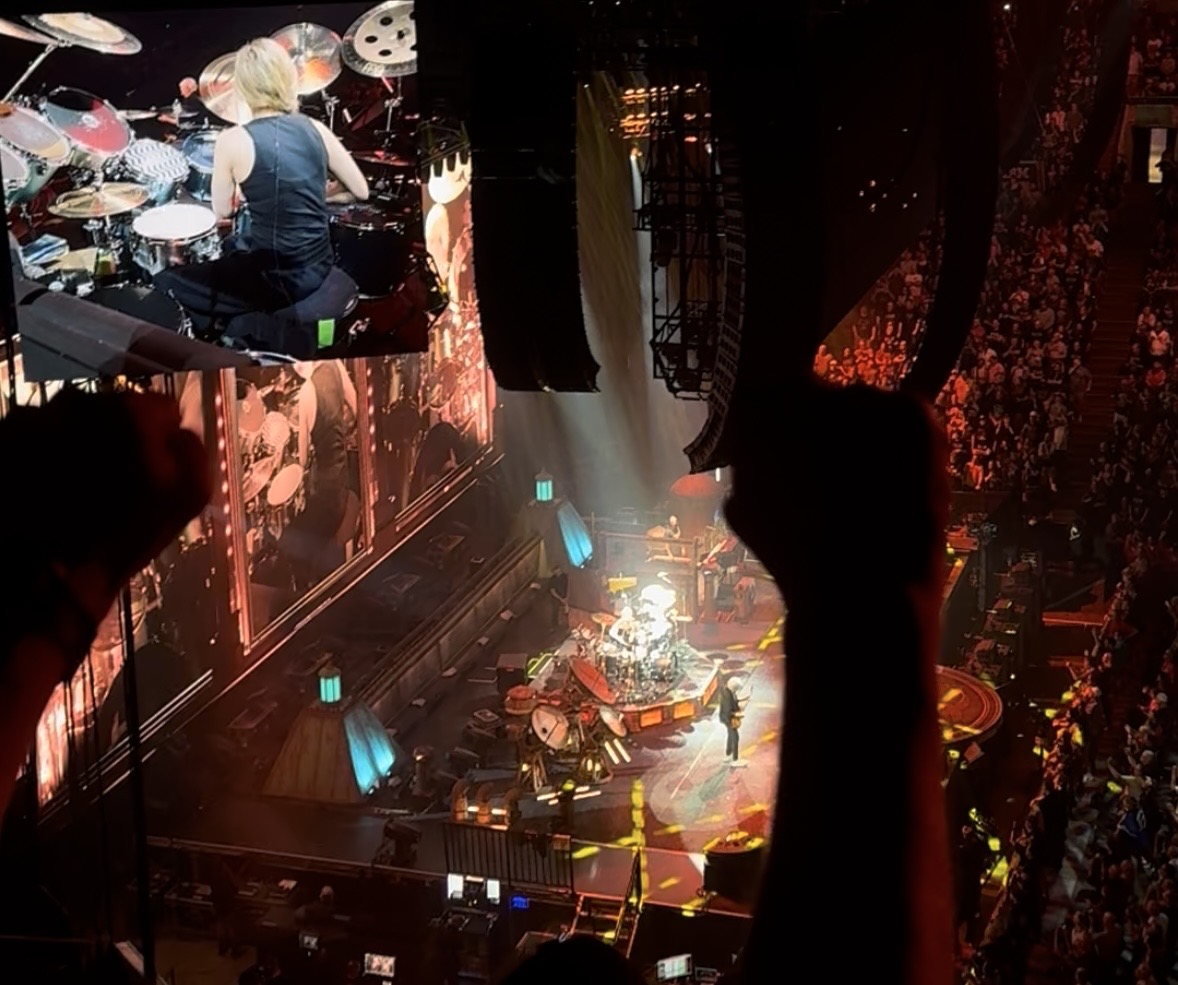
The climax of the show arrived at the end of the second set—“Tom Sawyer.” Not only is it their most popular song, but it features one of the most famous drum solos that Nilles had to live up to. Peart even said “Tom Sawyer” was one of the most difficult songs to play, due to the speed and stamina required. Everyone held their breath while Nilles played the solo, and she completed it with absolute perfection. The crowd was louder than ever, hurting my ears even through the cotton I wore. Lifeson and Lee, their faces on the big screen, were unable to hold back their smiles, as were my dad and I. That was the part that made me the most emotional: to see a woman like me take on the role of a man famous across the globe for a band whose audience is notoriously made of men (the lack of a women’s bathroom line speaks for itself). That Nilles has had an overwhelmingly positive reception, blowing away the fans who are infamously devoted and protective, was the key moment of the show for me.
After the encore of “Finding My Way” and “Working Man,” we were left satisfied yet still wanting more. How does one leave the best show of their life without a gaping hole in their chest, longing to experience it again? The walk out of the arena to the subway was complete with strangers (i.e. my dad and others) excitedly telling each other their favourite parts of the show and how many times they’d seen Rush in the past. As the tour continues, it’s unclear if Rush will be back later in life. At the very least we will have a Fifty Something concert movie, filmed in Toronto, to look forward to.