
Music in the Media: A New Age of Consumption
- NOV. 14, 2025
- //
- WRITTEN BY ISLA GRAY
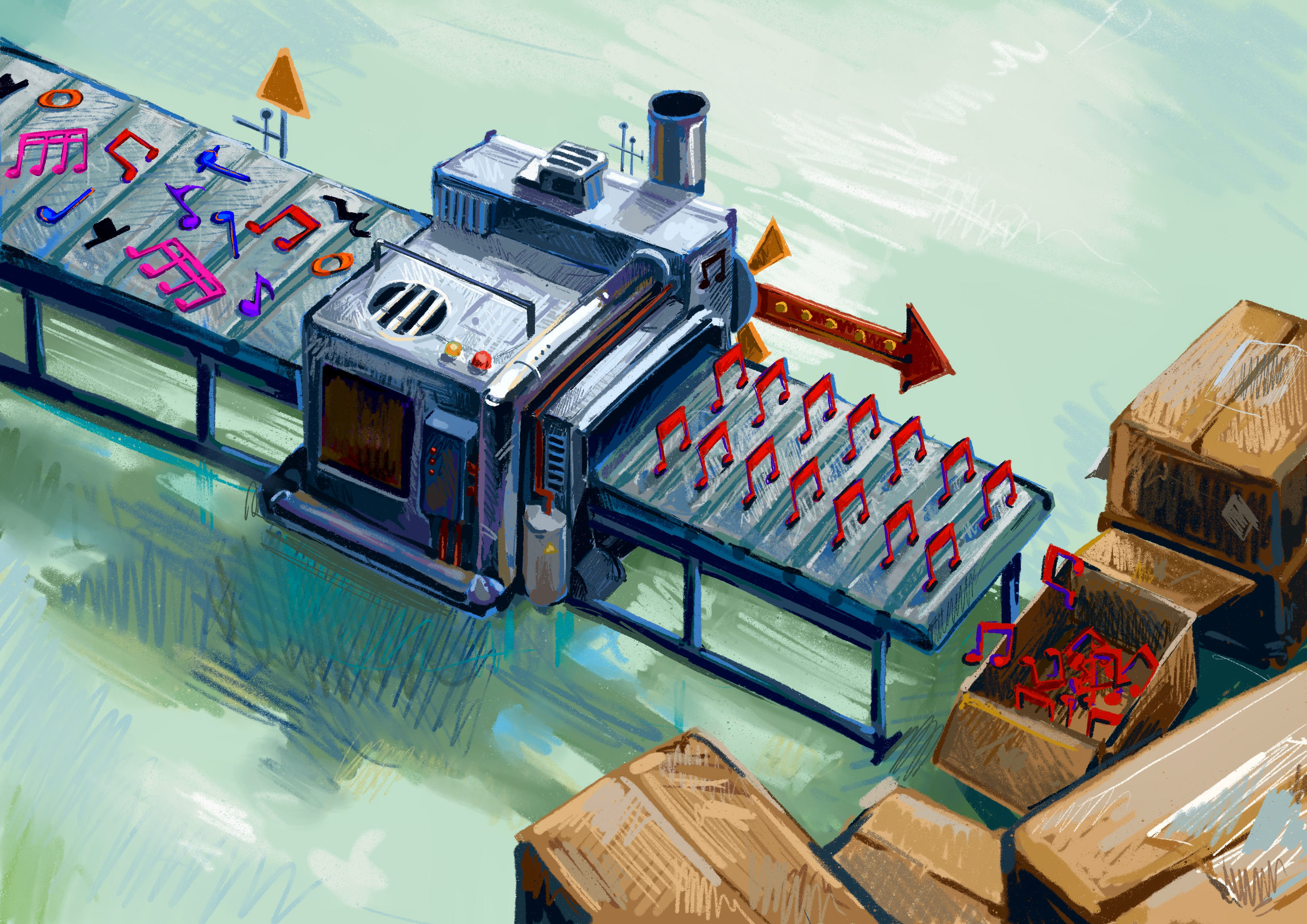
Illustration by Grace Lu
We live in a world where the lifespan of music can be tracked in days, not years. A song that once defined an entire generation can now be forgotten almost overnight. The timescale on which music is produced, consumed, imitated, and eventually considered culturally irrelevant is rapidly evolving. What once existed as iconic eras of music has transitioned into a series of microtrends, quickly replenishing an already crowded market. The rise of technology and short-form content has revolutionized the music industry—but how have these changes evolved, and what are their implications on the way we create and consume music?
Looking back across the past century, music was predominantly defined by decade. Think: the golden age of 60s British rock, led by bands like The Beatles, the 80s synth-pop dominance of artists like Duran Duran, or the early 90s grunge and alternative revolution, as seen with Nirvana and Pearl Jam. These eras were not just trends in music, but entire movements that reflected pop culture and shaped generational identity. But as technology evolves, the speed and ease at which music can be created and shared has skyrocketed. Software like GarageBand puts music production in the hands of the masses, while the expansion of streaming services has escalated consumer access. The rise of the independent artist and the approachability of music production go hand and hand, amplified by the relaxation of the rules on music publication. Without needing to be tied to a large production company or bound by the constraints of physical media, new and independent artists can create music more freely. While this has allowed new and diverse perspectives to enter the market, it has also opened the floodgates to an overwhelming flow of new content. In an industry where it once took years for a select few artists to define their sound, thousands can now create, upload, and share music within a matter of weeks. On top of that, the sudden growth of short-form content platforms like Instagram and TikTok have created a completely new set of expectations. The nature of these spaces pressure artists who wish to promote their music to constantly produce new content in order to compete with and capitalize on the evolving algorithm. As a result, instead of focusing on lasting impact, music has become about what is trending today.
The implications of this shift in music promotion are profound, especially once we consider how listeners, both fans and the general public alike, interact with musicians. With the endless stream of content provided through social media, we have become accustomed to instant gratification. In the eyes of the media, quantity has become prioritized over quality. Carefully crafted and complex albums like Hozier’s Unreal Unearth often lose mainstream recognition to hit viral sensations such as his own “Too Sweet,” which exploded online while the rest of the album was not as widely appreciated. The focus has shifted towards these recognizable and replayable hooks tailored for social media. Think of the last viral song you heard on TikTok or Instagram. Can you remember the rest of the song? Can you remember other songs by the same artist or on the same album? Music now feels disposable—instantly consumed and replaced just as fast by the next viral hit.
The evolution of music production and consumption reflects a shift in how we engage with music, art, and culture as a whole. The once-iconic, era-defining genres of music have given way to short-lived microtrends, driven by technology and social media. As music becomes more accessible to both musicians and consumers, the demand for consistent content output rises, often favouring virality over uniqueness or artistic quality. While the increased approachability of music has undoubtedly made way for new and diverse artists, it has also created a paradox: in an industry where anyone can make music, fewer artists can actually stand out and truly be heard.
Ultimately, music has always been more than just entertainment. As patterns of music production change, so does their reflection of society. If ingenuity is no longer valued and songs become disposable, we risk losing their legacy and cultural impact. As artists and fans, we must seek balance and embrace innovation. The question remains of our capability of adaptation and whether or not we will escape the monotony of the music industry.