
Memory Ain’t Fact: An Interview with Hana Bryanne
- AUG. 31, 2026
- //
- WRITTEN BY MILENA TALLARICO
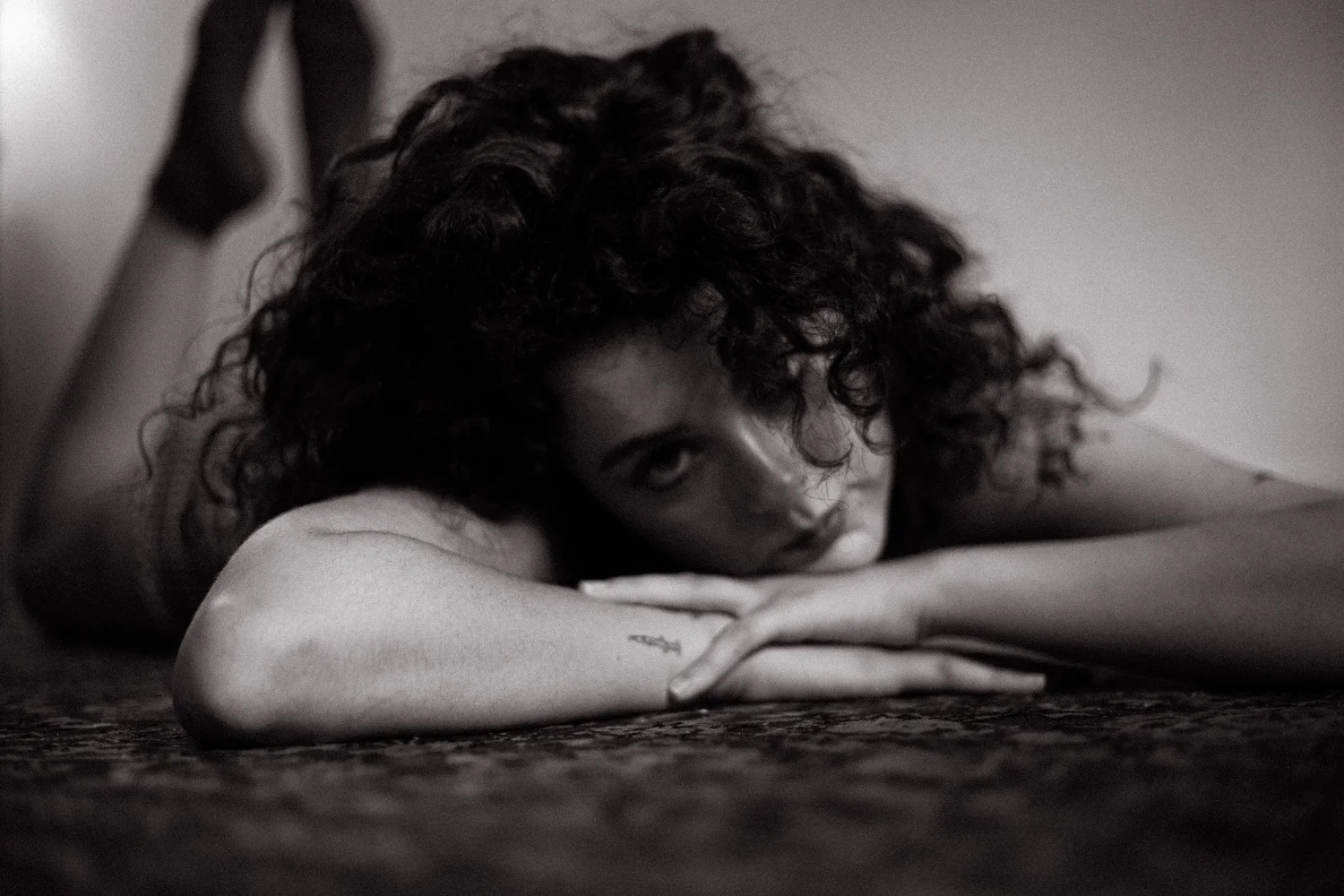
Indie-rocker Hana Bryanne is no stranger to a journey: the winding roads, the restless introspection, and the indescribable pull towards some greater force. On her debut album, Dollface, she first charmed listeners with her precocious wisdom, narrating the throes of her adolescence through a series of pop melodies stirred in dreamy production. Three years later, she returns with her sophomore record, This Is Not A Place Of Honor, a tight-knit collection of country-leaning tunes. Across the ten tracks, Bryanne hones in on her concision while allowing each song to tell a vast and lingering emotional tale, many of which span just below the five-minute mark.
The album’s title comes from a larger collection of nuclear semiotics that began development in the 1980s to deter generations in the distant future from intruding on nuclear waste repositories. In her newsletter, Bryanne poses the question, “What could “honor” even mean when you are so long forgotten, no one remembers even the language you spoke?” She begins to tackle this very idea on the opening track, “Ain’t It Just,” a song that opens with acoustic guitar strumming and builds towards a vibrant string arrangement. Her lyrics are playful but biting; each clever remark fleshed with the weight of its implications. “Made no promise, but I kept it/In your honor, acquiescent,” she sings in the second verse as the percussion intensifies around her vocals, beating a strong pulse until it softens to isolate the line, “But I’m where you left me last September/You might not, but I remember.” What does it mean to be the sole keeper of these memories? To live in a state of limbo between the past and future that in no way resembles the present?
On “May December,” the track that most closely resembles Bryanne’s earlier popstar tendencies from Dollface, the narrator relies on measurable platitudes to dictate how long it’ll take for the pain of these memories to subside: “What's that rule about/Half the time you were/In love with her to move on?” and then later, “Seven good years, and then/My cells will turn over/And you'll never have loved them.” Brimming with harmonies and punctuating instrumentation, the song finds its resolve in the bridge when Bryanne concedes, “Nowhere further west to move/So maybe I'll just move on.” Nevertheless, the album closer takes listeners as far west as you can go, to an imaginary land of the past that the singer deems, “Nowhere, CA.” No matter how far out of reach or incongruent with the present it may be, Bryanne asserts in a steadfast country drawl, “when it all goes bad, we can always go back.” Not a plea, but a promise.
I had the honour of speaking to Bryanne ahead of the album’s release to discuss her sonic, formal, and creative influences as well as her retroactive insights from the record. The following conversation has been edited for clarity.
Your sound has evolved since the release of your first album, Dollface. How did you decide that you were going to write a country record?
HB: I have always really loved country music. I think the first time that I knew I wanted to be a singer was when I went to see Miranda Lambert and the Pistol Annies at the outdoor amphitheatre in the city nearby where I grew up. Country radio was always on in my dad’s car when I was a little kid, and as I got older, there have been a lot of country records that have cradled me throughout different times in my life: Gillian Welch, Lucinda Williams, and of course, Dolly Parton. It felt natural for me to sing that way—I grew up in Northern California, but my mom is from the south, so it’s a big part of our family history. It was a natural songwriting impulse that sometimes I suppressed in favour of other things, but it just felt right. I also think thematically a lot of the things I was writing about were themes that come up in country music.
In 2024 you released “Jesus Or Harrison Ford” which marked your entry into the country genre. Was this single ever on the original tracklist for the album, and how do you decide when certain songs get cut?
HB: That song was never going to be on this album tracklist, it was a standalone thing. Deciding which songs get cut is really hard. Making an album and writing a collection of songs are two very different things, at least to me. When I make records, I try to have a really clear understanding of what it is that I’m trying to say but also be willing to let that change and watch it evolve over time. I cut songs because I felt like they were doing the same things as other songs—filling the same niche, talking about the same things. It can be really hard to kill your darlings, but it was important to me to keep this tracklist tight and make sure that it felt like a cohesive listening experience. There are definitely songs I’ve put on the backburner that’ll come out later, but this album felt like it was just about a couple of things, and I wanted to dig my shoulder into those thematic points and let everything else rest.
The album’s title, This Is Not A Place Of Honor comes from a nuclear warning message. Is this album giving its own warning to listeners?
HB: I think it can be really easy to give greater weight to memories of a certain colour than others. Just because things are ugly doesn’t mean that they’re bad and that they’re more powerful than any other things. If this album is a warning it’s, “don’t let ugly memories or ugly feelings spin themselves into something larger than they are.” The warning might also be, “nobody gets to tell you who you are and what matters to you, not even you.”
Some of the other titles you considered were “Journeys End In Lovers’ Meeting” from Shakespeare’s Twelfth Night as well as “More Light Than Heat” from Hamlet. Does this album feel particularly Shakespearean to you?
HB: In some ways, I think so. One of the challenges of songwriting is that it’s not as rigidly metered as some poetry is, but it is all about making things scan into a melody, fit into a form, and then subsequently adjusting the form to fit the ideas. I think that I learned a lot from Shakespeare about songwriting and about how words feel in the mouth. There are also a lot of books that I love that have interpolated lines from Shakespeare, including The Haunting of Hill House by Shirley Jackson and Blackouts by Justin Torres, which were equally influential on the writing of the record. The line “Journeys end in lovers’ meeting” can mean so many things, and that’s another really beautiful thing about Shakespeare in modern works of art: it’s like a jackknife that can be employed in so many different ways.
There seems to be a connection between the tracks “Journeys End” and “Jacket,” not just because “Jacket” reprises the line “Journeys end in lovers’ meeting,” but also because both songs deal with depictions of death and contend with modern masculinity. Were you conscious of that link while writing them?
HB: I knew that those songs were connected in that those are things that I’m thinking about all the time, and they were songs that I wrote in the later half of writing the record. “Jacket” was the last one I wrote, and “Journeys End” was also back there. “Journeys End” is a very fictionalized story. I wanted to write a 40s murder ballad—I had been listening to a lot of Bob Dylan and this Aoife O’Donovan side project called Crooked Still, who have a lot of really great covers of classic folk murder ballads. I really wanted to write a song like that, so “Journeys End” feels like a really personal and real but also fictionalized version. Whereas there’s nowhere to hide on “Jacket.” All of it feels autobiographical. I think they’re sister songs in that way; they’re talking about the same thing but from slightly different lenses.
Your music video for “Parker Posey” takes inspiration from the film Party Girl (1995). Were there any specific references you wanted to make or ideas you wanted to execute while filming?
HB: We shot that just before my 24th birthday and I knew I wanted to reference the part when Parker Posey’s character says, “I’m almost 24 and I haven’t done anything with my life.” I feel that way. I also wanted to capture the queerness and the community aspect you see in Party Girl which is so based around fun. There’s all these beautiful drag queens and her group of party gays and, in some ways, that’s the heart of the film: how gay it is. I really wanted to sink my teeth into the fun that movie has with queerness and how celebratory it feels. I also really wanted an excuse to get my sister and her friend involved as The World’s Most Interesting Sisters.
On your previous album, Dollface, you introduced the character “Susannah” as a “cool girl” archetype. Do “Parker Posey” and “Miss Wisconsin” feel like their own archetypes?
HB: I’m “Parker Posey” in that when men see a beautiful woman who’s weird in the way that Parker Posey was the “Queen of the Indies”—she had this atypical persona that didn’t fit into the mainstream—the only way that men understand how to love that is through controlling it. I felt like I had been in relationships where I hadn’t been loved but there was a desire to control me. All of the things that someone would purport to have fallen in love with, when they’re actually in the relationship, are suddenly points of conflict. “Parker Posey” is this archetype of a real woman who exists beyond a sex symbol. But “Mary” is completely open to interpretation; she can be whoever you want her to be.
“Miss Wisconsin” is a very specific person. She’s my best friend Ruby who’s from Wisconsin. I love that line about her on “Benchwarmer” where I say, “He was nice enough but just a little boring…You know that all I want is already yours/We can run lines when I get back from tour.” All of those really central, joyous relationships on this album are those with my girlfriends. That played into the theme of “don’t let the ugly emotions carry more weight than the ones that feel commonplace.” Sometimes we can take friendships for granted and it can be a pretty pedestrian thing, but if you really stop to look it in the eyes for long enough, it’s the greatest magic I’ll ever experience.
On “Benchwarmer” you sing, “the greatest line’s already in a song.” What is the greatest line, in your opinion?
HB: It’s either on Patty Griffin’s “Chief” where she says, “I don't really know what I'm doing/Just watching myself in some play/And the actress looks like she wants to go home/And lie in a bed all day” or on Bruce Springsteen’s “Racing in the Street” where he says, “She sits on the porch of her daddy's house/But all her pretty dreams are torn/She stares off alone into the night/With the eyes of one who hates for just being born.”
What lines are you most proud to have written on this record?
HB: I think that “Memory ain’t fact/But it’s good for what it’s good for” is one of the theses of the album. I also really love to sing “Ain’t It Just” live, especially the line, “At least I’m always someone’s daughter.”
Much of this album is concerned with memory and the idea of the past as a metaphysical place. What insights did you gain about your own memories while writing it?
HB: Songwriting has always been a way for me to dig my fingers into my own emotional experiences. Sometimes you write a song and think, “I didn’t know I felt that way” or “maybe I don’t but it was fun to try that on and say something like that out loud.” I would try to write love songs about the people I was dating, and then all my love songs would end up being about my best friends.
You wrote in your newsletter that all the love songs on this album are about your friend Ruby Henley.
HB: She is my most trusted songwriting partner. She’s the only person I let in the room to write with me. I adore her, she’s a genius.
To me, this album feels like the perfect soundtrack for a road trip. Do you have an ideal setting for your fans to listen to it?
HB: I wrote a lot of it in the car on the drive from LA up to my hometown which is south of San Jose, so that stretch of the I-5 where California feels so huge and never-ending and expansive. Letting yourself be washed in your own smallness and the hugeness of the universe. One of the great joys of being an artist is for people to have an experience with your work that’s very intentional and focused, but I also think that one of the really blissful things about being a musician is that I want this music to slot into people’s lives in unexpected ways. There’s not a lot of grandeur to this album—despite some of the string arrangements—it’s all about very small moments in time in my life that have felt like they have a greater magnitude, but in reality, have been quite simple. I think that I wanted to make music that people don’t have to make room for but can slot itself into wherever they are.